
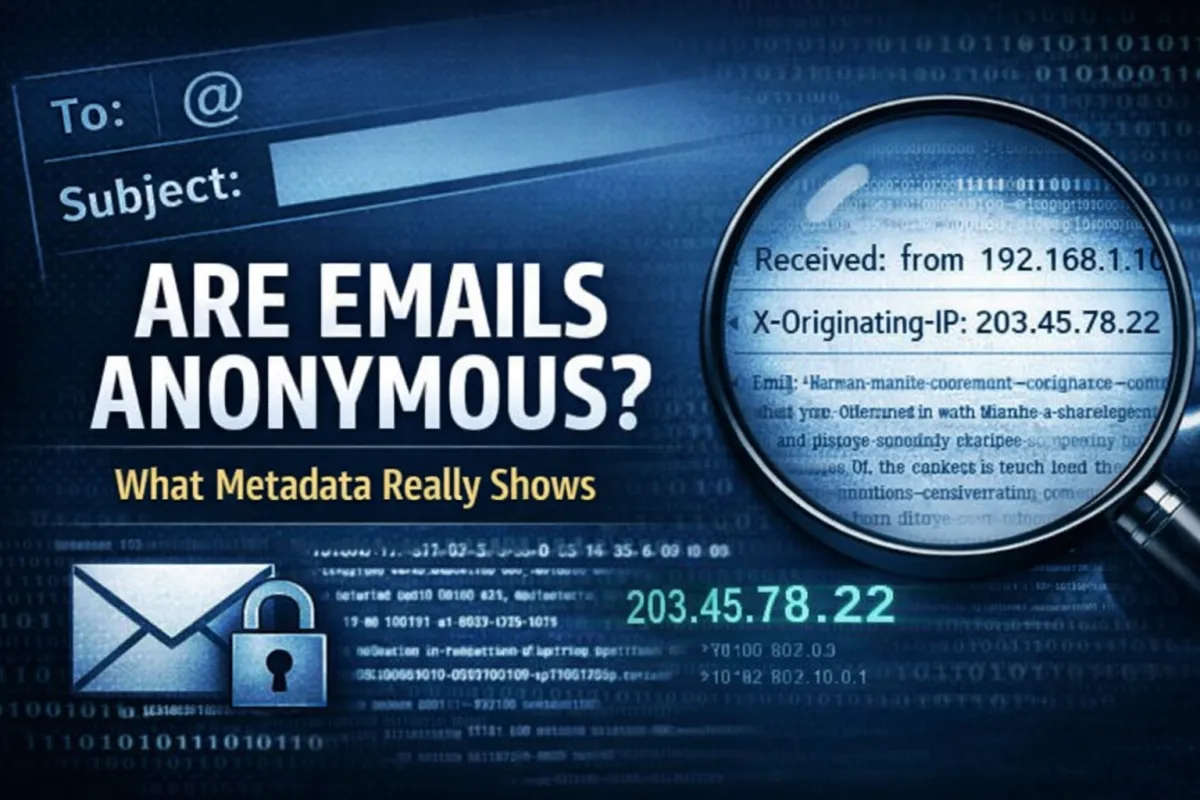
Are Emails Anonymous? What Metadata Really Shows
Most people think emails are private.
Some even think they are anonymous.
They are not.
When you send an email, you send more than words.
You also send hidden data.
This hidden data is called metadata.
Metadata tells a story.
And in many cases, it can identify who sent the email.
What Is Email Metadata?
Metadata is data about data.
It does not show in the body of the email.
But it exists behind the scenes.
Email metadata can show:
The sender’s email address
The sending mail server
The time and date sent
The path the email travelled
The IP address used to send it
This information is stored in the email header.
Most people never look at it.
But investigators do.
Are Emails Anonymous?
No.
Even if someone:
Uses a fake name
Creates a new email account
Hides behind a nickname
The system still records technical data.
To send an email, the message must pass through servers.
Those servers log activity.
That activity can be traced.
In court matters, this data can be used to:
Link a person to an account
Show where the email was sent from
Establish timelines
Support or challenge credibility
What Information Can Be Extracted?
When handled properly, forensic analysis can extract:
1. Full Email Headers
This shows routing information and server records.
2. IP Address Data
This may show the location or internet connection used.
3. Account Creation Information
In some cases, service providers hold subscriber details.
4. Device Artefacts
If the device is seized, forensic tools can show:
Login activity
Saved credentials
Draft emails
Deleted messages
All of this helps explain how the email came to exist.
Why Screenshots Are Not Enough
Many people provide:
Screenshots
Forwarded copies
Printed emails
This removes or alters metadata.
If metadata is not preserved, you may lose:
Routing data
Header integrity
Authentication records
That can weaken evidence in court.
Proper forensic extraction preserves the original data.
That is what courts rely on.
Why Context Matters
Finding an email is one thing.
Proving who sent it is another.
Investigators must consider:
Was the account compromised?
Was the device shared?
Was the email auto-generated?
Was it spoofed?
Metadata must be interpreted correctly.
This is where experience matters.
When Should You Seek Expert Advice?
If your matter involves:
Threatening emails
Harassment
Fraud
Contract disputes
Family law disputes
Anonymous communications
You need to understand what the metadata says.
And what it does not say.
Misinterpreting digital evidence can damage a case.
We Help Law Firms Interpret Email Evidence
At Conseek, we specialise in independent digital evidence analysis.
I personally spent over a decade with the NSW Police, working complex digital investigations.
We now assist law firms with:
Email header analysis
Metadata interpretation
Forensic extraction
Expert reports
Court-ready digital evidence
If your firm is dealing with contested emails and needs clarity, contact us.
Because in digital investigations, what is hidden often matters more than what is visible.